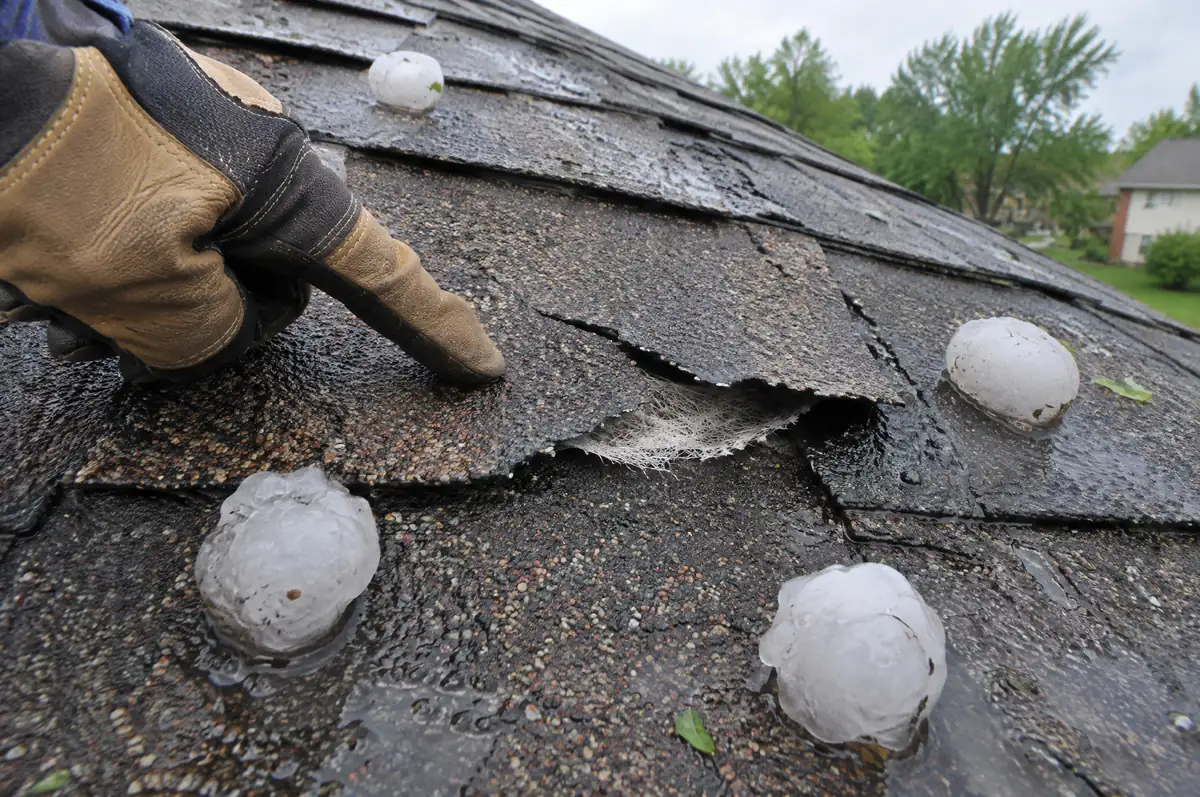
How does hail damage a roof?
Asphalt shingles are a fiberglass mat soaked in asphalt and covered in mineral granules. The granules shield the asphalt from ultraviolet light. When a hailstone hits, it can knock granules loose, crush the asphalt beneath and, on a hard hit, crack the mat itself. The shingle may still keep water out that afternoon, but the bruised spot ages much faster in the sun and can open into a leak months later.
Metal parts show hail differently. Ridge vents, turtle vents, pipe jacks, gutters and downspouts dent, and those dents are often the first clue an adjuster uses to judge how big the stones were. Soft metals on the ground, such as AC fins, mailboxes and grill lids, tell the same story.
What size hail damages a roof?
There is no single cut-off, because shingle age, wind speed and the angle of the storm all matter. As a rough guide used by roofers and adjusters:
| Hail size | Common comparison | What it usually does |
|---|---|---|
| Under 3/4 inch | Pea to dime | Rarely damages a sound roof; may scuff very old shingles. |
| About 1 inch | Quarter | Can bruise older or brittle shingles and dent soft metal. |
| 1.25 to 1.75 inch | Half-dollar to golf ball | Frequently damages shingles of any age; common cause of full-roof claims. |
| 2 inches and up | Hen egg to baseball | Cracks shingles, punctures skylights and dents metal roofs. |
Wind-driven hail does more damage than hail falling straight down, and slopes facing the storm take the worst of it. Our guide what hail damage looks like on a roof has more detail on spotting it.
What does a hail damage inspection include?
- Ground check. Gutters, downspouts, window screens, siding, fences and AC units are checked for hits that confirm hail size and direction.
- Roof walk. Each slope is inspected. Roofers often mark a 10-by-10-foot test square and circle every hit in chalk, because that is how many insurers assess damage.
- Soft metals. Vents, flashing and pipe jacks are photographed close up.
- Attic. A quick look for daylight or fresh water staining.
- Report. You should get dated photos and a plain summary: no damage, repairable damage, or damage that likely supports a claim.
Repair or replace after hail?
If hits are confined to one or two slopes, or the roof is newer and only soft metals were damaged, a targeted repair or vent replacement may be enough. If most slopes show functional damage, insurers usually pay for a replacement, because patching dozens of bruised spots does not restore the roof. Many policies also consider whether repaired sections can be matched to the rest of the roof. Your adjuster makes the coverage decision; a roofer's job is to document the damage clearly so that decision is based on the full picture.
If you are replacing, it is a good moment to look at impact-resistant roofing, which can lower future claims and may earn a premium discount.
How soon should you act after a hailstorm?
Soon. Insurance policies set deadlines for reporting damage, and the longer you wait, the harder it is to show which storm caused it. Damage that is not leaking today can still let water in during the next rain. Practical steps:
- Write down the date and time of the storm and photograph hail on the ground with a coin for scale, if it is safe.
- Photograph dents on gutters, vents you can see, cars and outdoor equipment.
- Book an inspection before you call the insurer, if you want to know whether a claim is worth filing.
- Check that any roofer who knocks on your door is registered with the Oklahoma Construction Industries Board.
Signs you should not ignore
- Granules collecting at downspout outlets after a storm.
- Round dark spots on shingles that feel soft, like a bruise on fruit.
- Dents on the ridge vent or turtle vents you can see from the yard.
- New drips or ceiling stains in the weeks after a storm.
Frequently asked questions
Can you see hail damage from the ground?
Sometimes you can see dents on gutters and vents, but bruised shingles are hard to spot from the yard. An on-roof inspection with marked test squares is the reliable way to know.
Will filing a hail claim raise my premium?
Hail is usually treated as a weather claim rather than a fault claim, but each insurer rates differently and premiums in Oklahoma have been rising in general. Ask your agent before filing if you are unsure.
Is a roofer allowed to pay my deductible?
No. Oklahoma law bars roofing contractors from advertising or promising to pay all or part of your insurance deductible. A contractor who offers this is breaking the rule and putting your claim at risk.
What if my roof was already old when the hail hit?
Older roofs can still have valid hail claims, but some policies pay actual cash value, meaning depreciation is deducted. Check your policy wording for roof payment schedules or actual cash value terms.
Can hail damage a metal roof?
Large hail can dent metal panels. Many metal roofs keep water out despite dents, and some policies exclude purely cosmetic damage to metal. Read your policy so you know how dents would be treated.
Do I need an inspection if my neighbors are getting new roofs?
It is worth one. Hail paths are uneven, so one house can be hit hard and the next lightly, but a whole street of new roofs is a strong hint to get yours checked.