Why hail damage is hard to see
From the yard, a hail-damaged roof can look completely normal. Asphalt shingles are dark and textured, and a hit that knocks loose a patch of granules the size of a nickel is almost invisible at 20 feet. The damage that matters most, a crack in the fiberglass mat or a crushed spot in the asphalt, may not show on the surface at all for weeks. Meanwhile, the roof has lost part of its protection from the sun, and the damaged spots age faster than the rest.
That is why roofers and insurance adjusters rely on a combination of ground clues, close-up roof inspection and simple tests. This guide walks through each so you know what you are looking at, and what to ask your roofer.
Step 1: Clues you can check from the ground
Hail that is big enough to damage a roof almost always leaves evidence elsewhere. Before anyone climbs a ladder, walk around the property and look at:
- Gutters and downspouts. Small round dents along the top edge or face of aluminum gutters, and dimples on downspouts.
- Granules. Piles of black or grey sand-like granules at downspout outlets or in the gutters. Some granule loss is normal on new roofs, but a sudden heavy pile after a storm is a warning sign.
- Window screens and frames. Torn or dented screens, chipped paint on wood trim.
- Siding. Cracked or holed vinyl siding, especially on the side facing the storm.
- AC units. Bent fins on the outdoor condenser.
- Soft metals. Mailboxes, grills, light fixtures and car hoods.
- Fences and decks. Spatter marks, where hail cleaned dirt or oxidation off wood or paint.
These clues show how big the hail was and which way it came from. They are also useful evidence for your insurer, so photograph them with a coin or ruler for scale.
Step 2: What hail damage looks like on asphalt shingles
On the roof itself, roofers look for "functional" damage, meaning damage that shortens the life of the roof or lets water in, as opposed to purely cosmetic marks.
| What you see | Likely hail? | How to tell |
|---|---|---|
| Round dark spot with granules missing, random pattern | Yes | Hits are scattered with no pattern, often with a soft spot underneath |
| Soft "bruise" that gives under thumb pressure | Yes | The mat has been fractured; feels like a bruise on an apple |
| Crack radiating from a hit | Yes | Often on older or cold shingles |
| Small round blisters that pop and leave bare spots | No, blistering | Usually from heat and trapped moisture; often in clusters on one slope |
| Granule loss in lines or worn areas | No, wear | Follows water paths, foot traffic or age |
| Scuffs and scrapes | No, mechanical | From tree branches, foot traffic or tools |
Hail hits on a slope facing the storm will usually be denser than on the sheltered slopes. If the damage is only on one small area and shows a pattern, it may be something else.
Step 3: Test squares and chalk circles
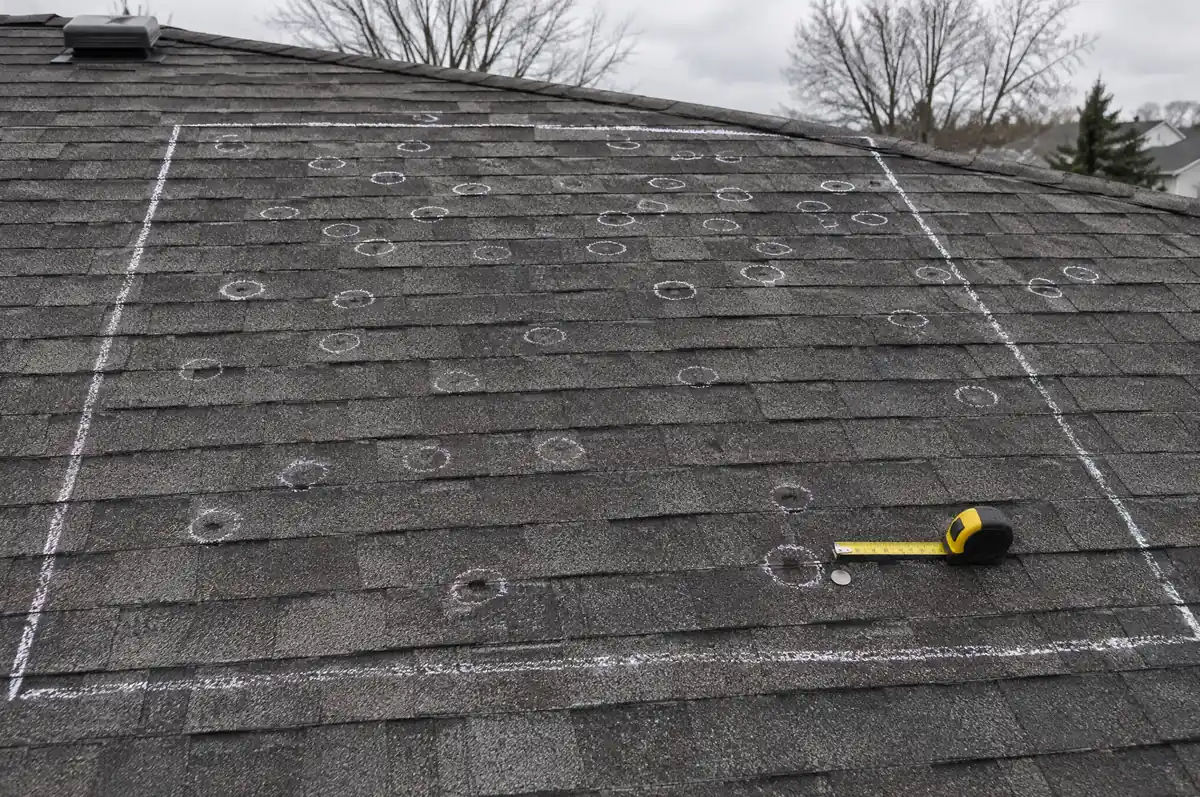
Many insurers and roofers use a test square to measure hail damage consistently. A 10-by-10-foot square (one roofing "square") is marked in chalk on each slope, usually away from edges. Every hail hit inside the square is circled in chalk and counted. The number of functional hits per square, along with the slope it is on, helps decide whether the slope needs repair or replacement. Insurers each have their own thresholds, so the count is evidence rather than an automatic answer.
When you see chalk circles on your roof, that is a good sign: it means the inspector actually got up and counted.
Step 4: Vents, flashing and metal parts
Metal on the roof is the easiest place to see hail. Look closely at photos of:
- Turtle vents and box vents, which dent easily.
- Ridge vents along the peak.
- Pipe jacks and their metal collars.
- Chimney caps and chimney flashing.
- Skylight frames and domes, which can crack.
- Satellite dishes and solar panel frames.
Dents in metal alone do not always mean the shingles are damaged, but they confirm that hail of a certain size hit the roof, which is why adjusters photograph them.
What size hail damages a roof?
There is no exact cut-off, but a rough guide used in Oklahoma is:
- Under about 3/4 inch: rarely damages a sound asphalt roof, though very old shingles may show marks.
- Around 1 inch (quarter-size): can damage older or brittle shingles and dents soft metal.
- 1.25 to 1.75 inches (half-dollar to golf ball): commonly damages shingles of any age.
- 2 inches and larger: cracks shingles, punctures skylights and can dent metal roofs.
Wind makes a big difference. Hail blown in at an angle by strong winds hits harder than hail falling straight down, and it concentrates damage on the windward slopes. Shingle age matters too: newer shingles are more flexible and absorb hits better than old, sun-baked ones.
Hail on other roof types
Metal roofs show round dents. Many metal roofs keep water out even when dented, and some insurance policies exclude purely cosmetic damage to metal. Tile and slate crack or chip, and broken pieces can slide out of place. Flat roofs with TPO, EPDM or modified bitumen can be punctured or crushed, and the insulation underneath can be damaged even when the membrane looks fine. Wood shakes split along the grain, with fresh, light-colored wood showing at the break.
Old hail damage versus new hail damage
If you file a claim, your insurer may ask whether damage came from the recent storm or an earlier one. Fresh hits tend to show bright, clean edges where granules came off and darker, shiny asphalt underneath. Older hits weather to a duller grey as the exposed asphalt oxidizes. This is one reason to have your roof inspected soon after each significant storm and to keep dated photos.
When to call for an inspection
Book an inspection if any of these apply after a storm in the Oklahoma City area:
- Hail about an inch or larger fell near your home.
- You see dents on gutters, vents or the AC unit.
- Neighbors are finding roof damage or getting new roofs.
- You notice heavy granules at downspouts.
- A new leak or ceiling stain appears in the weeks after a storm.
Calls are answered 24/7. For what happens after an inspection, see hail damage roof repair in Oklahoma City and our guide to whether insurance covers hail damage.
Safety first
Please do not climb onto your roof to look for hail damage. Roofs are slippery after storms, hail-damaged shingles can slide, and falls from roofs are a common cause of serious injury. Everything in Steps 1 and 4 can be checked from the ground with a good camera zoom, and a roofer can do the rest.
Frequently asked questions
What does fresh hail damage look like on shingles?
Fresh hits usually show as round dark spots where granules have been knocked off, often with bright clean edges and a soft, bruised feel underneath. They appear in a random scatter rather than a pattern.
Can a roof have hail damage without leaking?
Yes. Most hail-damaged roofs do not leak right away. The bruised spots age faster and may leak months later, which is why inspections matter even when nothing is dripping.
Does quarter-size hail damage a roof?
Quarter-size hail, about an inch across, can damage older or brittle shingles, especially when driven by wind. Newer, more flexible shingles may come through it with little damage.
How do adjusters count hail damage?
Many use a 10-by-10-foot test square on each slope and count the hail hits inside it. The count, along with damage to metal parts, helps them decide on repair or replacement.
Are dented gutters proof of roof damage?
Dented gutters show that hail of a certain size hit the house, but they do not prove the shingles were damaged. An on-roof inspection confirms it.